
A New Molecule, Microglia, and Alzheimer's: What the Research Really Shows
A recent wave of headlines announced that scientists had found a molecule that "restores the brain's natural defenses against Alzheimer's." The research behind the headline is real, careful, and genuinely encouraging. It is also very early, and the distance between the headline and the data is worth understanding, especially for families searching for hope.
The Brain's Cleanup Crew
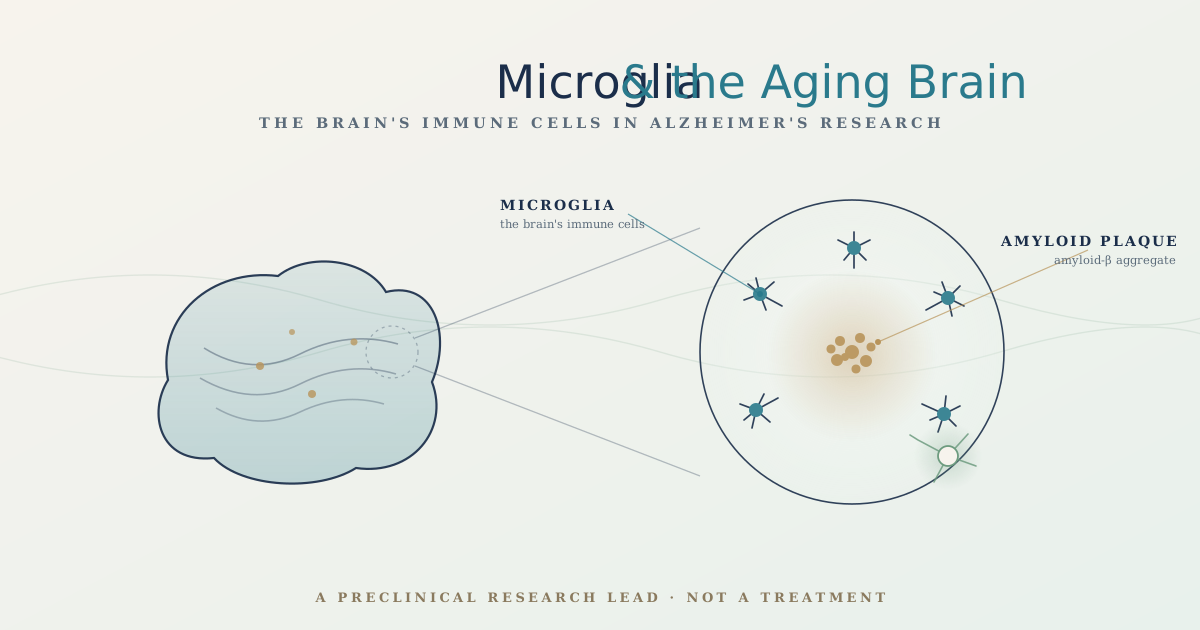
The study centers on microglia, the brain's resident immune cells. Think of them as a cleanup and repair crew. Among other jobs, they gather around the sticky amyloid plaques associated with Alzheimer's and help wall them off from healthy neurons.
As the disease advances, microglia often become less effective at this work. Plaques spread, the toxic material around them diffuses outward, and nearby nerve fibers are damaged. Helping microglia do their job again has become an active area of Alzheimer's research.
What the Study Actually Did
Researchers at the Institute for Neurosciences in Spain studied a molecule called OLE (N-oleoyl-L-leucine), one of the compounds the body can build through a gene called PM20D1 that earlier work had already linked to Alzheimer's. The OLE used in these experiments was made in the laboratory.
They tested it in worms and mice, not people. In genetically engineered mice that overproduce amyloid, three months of OLE in the drinking water was associated with better performance on memory tests, lower brain levels of amyloid, and fewer plaques. A single-cell analysis showed that microglia responded most strongly to the treatment: they clustered around plaques and formed a tighter barrier, with less of the toxic "halo" that usually surrounds them. Published in Cell Death & Disease in April 2026, the work describes a plausible biological pathway.
Why "Restores the Brain's Defenses" Needs Context
That phrase is the press release's shorthand, and it runs ahead of the evidence. No person received this molecule. The findings come from worms, cultured cells, and one kind of genetically engineered mouse, plus an indirect analysis that looked for similar gene patterns in donated human brain tissue. That last step is a supportive clue, not proof that OLE helps human Alzheimer's.
The mouse model is also narrow. It reproduces amyloid buildup but not the tau tangles, widespread neuron loss, and aging biology that define most human Alzheimer's. The study was small, used only male mice, and the researchers themselves note these limits.
One Point Families Should Not Miss
OLE is a specific laboratory-made molecule. It is not olive oil, and it is not an oleic acid or leucine supplement. In the experiments, neither oleic acid nor leucine on its own reproduced OLE's effect. No product on a store shelf is the compound being studied, and there is no evidence that any supplement does what OLE did in mice.
Where This Fits in the Bigger Picture
Alzheimer's research has learned to stay humble. Recently approved drugs that lower amyloid, such as lecanemab and donanemab, do modestly slow decline in early disease, which shows that changing amyloid can matter. Yet other amyloid-lowering treatments have cleared plaques without helping patients, and past efforts to rev up microglia have looked promising in mice and then fallen short in human trials. Compelling animal biology is a beginning, not a finish line.
The Takeaway
This study points to a credible new lead and a biological pathway worth pursuing, not a treatment that exists today. The honest next steps are the patient ones: independent replication, studies in both sexes and in more human-like models, learning exactly how OLE works, careful safety testing, and only then trials in people. For families, the encouraging news is that serious science is moving forward. The realistic news is that this is the start of a long road.
At East End Neuropsych, we help older adults and their families make sense of new research and what it does and does not mean for real decisions about memory and cognition. If you have questions about Alzheimer's, memory changes, or a loved one's care, contact our office to ask about an evaluation or consultation.
This article is for educational purposes and does not constitute medical advice. Always consult your healthcare provider for individual diagnosis and treatment, and do not start or stop any medication or supplement without medical guidance.