
What a Simple Reflex Exam May Reveal About Future Dementia Risk
When an older parent's doctor taps the bridge of their nose or strokes the palm of their hand during a checkup, it can look like a throwaway gesture. It often isn't. A small set of reflexes that most of us outgrow in infancy can quietly return later in life, and new research suggests that when several of them appear together, they may offer an early, low-cost clue about who could benefit from closer cognitive follow-up.
What Are Frontal Release Signs?
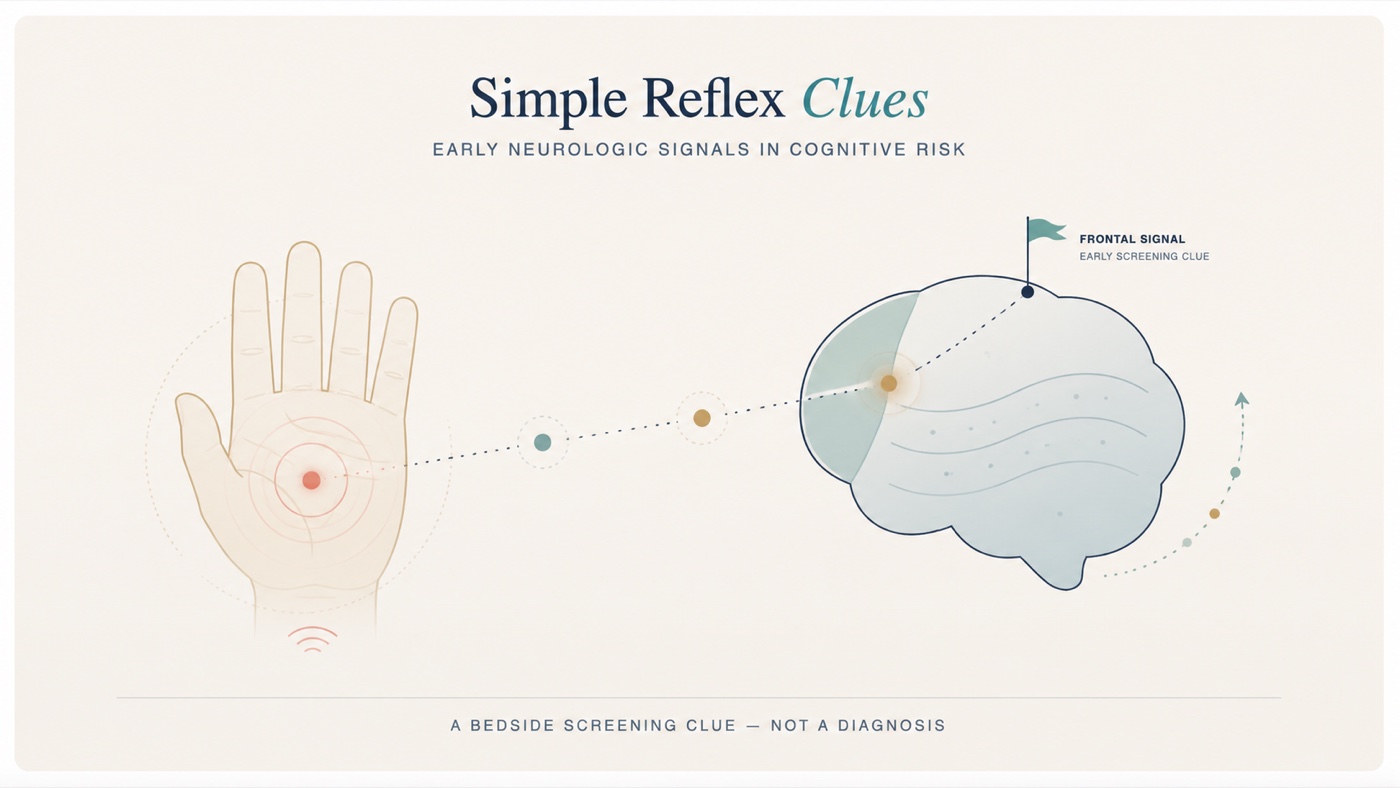
Frontal release signs, sometimes called primitive or regressive reflexes, are automatic responses we are all born with. In healthy adults, the brain's frontal lobes keep them switched off. When those frontal networks change with age, injury, or neurodegeneration, the reflexes can "release" and reappear.
Clinicians check for them with simple, painless maneuvers. A few of the common ones:
- Palmomental: lightly stroking the palm triggers a small twitch in the chin.
- Grasp: the hand closes involuntarily around an object placed in it.
- Snout or rooting: a light touch near the lips prompts a puckering or turning response.
- Glabellar (Myerson) sign: repeated taps on the forehead keep triggering a blink that should normally fade.
Any one of these can show up in a perfectly healthy older adult. What researchers wanted to understand was whether having several of them at once carried real meaning.
What the New Study Found
In a study published in JAMA Network Open in June 2026, investigators at the University of Kentucky followed 873 older adults (average age 77) for several years. They counted a person as "reflex-positive" when two or more frontal release signs were present.
Among participants who started with normal cognition, those who were reflex-positive were more likely to develop dementia over time. About 25% progressed, compared with roughly 15% of those without the signs. After accounting for age and other factors, that came to an 80% higher relative risk. Memory and executive thinking also declined somewhat faster in this group.
One detail matters as much as the headline. The signal held only for people who began with intact cognition. In those who already had mild impairment, the reflexes did not predict who would go on to develop dementia.
An Important Caveat: This Is Not a Dementia Test
It would be easy to read a result like this and assume a single reflex settles the question. It does not. The study's own authors are clear that frontal release signs miss many people who are genuinely at risk, and that a positive finding is far from a guarantee. Most reflex-positive participants did not develop dementia during the study.
What these reflexes offer is a quick, noninvasive, inexpensive piece of information: one thread in a much larger picture that also includes memory testing, medical history, lab work, and sometimes brain imaging. They are a reason to look more closely, not a verdict.
What This Means for Families
For an adult child watching a parent age, the practical message is steadying rather than alarming. If a clinician notes these signs, it points toward thoughtful follow-up, not panic. And if the signs are absent, that alone does not rule anything out.
The signals families tend to notice at home still matter most: repeating the same questions, trouble managing money or medications, getting lost on familiar routes, or shifts in mood and personality. Those everyday observations, paired with a careful exam, are what move an evaluation forward.
When a Cognitive Evaluation Makes Sense
A formal cognitive or neuropsychological evaluation is worth considering when changes in memory or thinking start to interfere with daily life, when family members notice a clear shift over months, or when a primary care visit raises questions that deserve a closer look. A thorough evaluation can separate normal aging from reversible causes such as medication effects, sleep problems, thyroid issues, or depression, and from a true neurodegenerative process. That distinction changes what comes next.
The Takeaway
A reflex check is a small but genuinely useful tool. In older adults with normal cognition, the presence of several frontal release signs may flag a higher chance of future decline and a reason for closer monitoring. It cannot diagnose dementia, and it never replaces a comprehensive assessment. Used the right way, as one part of a complete evaluation, it helps clinicians decide where to look more carefully and how closely to follow someone over time.
At East End Neuropsych, we evaluate memory and cognitive concerns in older adults with exactly this kind of layered approach, combining neurological examination, neuropsychological testing, and a careful medical and psychiatric history. If you or a family member has noticed changes in memory or thinking, contact our office to ask about a comprehensive evaluation.
This article is for educational purposes and does not constitute medical advice. Always consult your healthcare provider for individual diagnosis and treatment.